Starting at the center, Earth is composed of four distinct layers. They are, from deepest to shallowest, the inner core, the outer core, the mantle and the crust. Except for the crust, no one has ever explored these layers in person. In fact, the deepest humans have ever drilled is just over 12 kilometers (7.6 miles). And even that took 20 years!
Still, scientists know a great deal about Earth’s inner structure. They’ve plumbed it by studying how earthquake waves travel through the planet. The speed and behavior of these waves change as they encounter layers of different densities. Scientists - including Isaac Newton, three centuries ago — have also learned about the core and mantle from calculations of Earth’s total density, gravitational pull and magnetic field.
Here’s a primer on Earth’s layers, starting with a journey to the center of the planet.
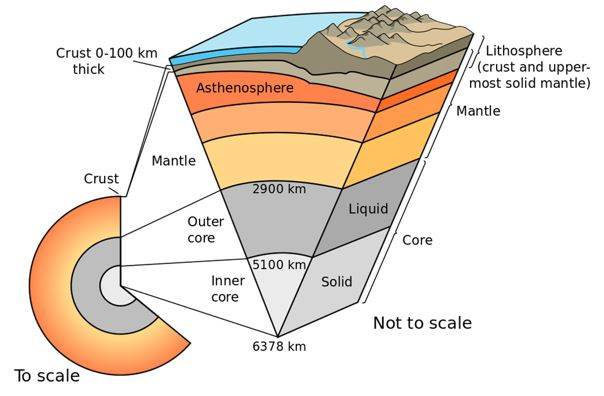 A cut-away of Earth’s layers reveals how thin the crust is when compared to the lower layers. USGS. https://www.snexplores.org/article/explainer-earth-layer-layer
This solid metal ball has a radius of 1,220 kilometers (758 miles), or about three-quarters that of the moon. It’s located some 6,400 to 5,180 kilometers (4,000 to 3,220 miles) beneath Earth’s surface. Extremely dense, it’s made mostly of iron and nickel. The inner core spins a bit faster than the rest of the planet. It’s also intensely hot: Temperatures sizzle at 5,400° Celsius (9,800° Fahrenheit). That’s almost as hot as the surface of the sun. Pressures here are immense: well over 3 million times greater than on Earth’s surface. Some research suggests there may also be an inner, inner core. It would likely consist almost entirely of iron. (Source : https://www.snexplores.org/article/explainer-earth-layer-layer)
What is the main idea of the passage above?